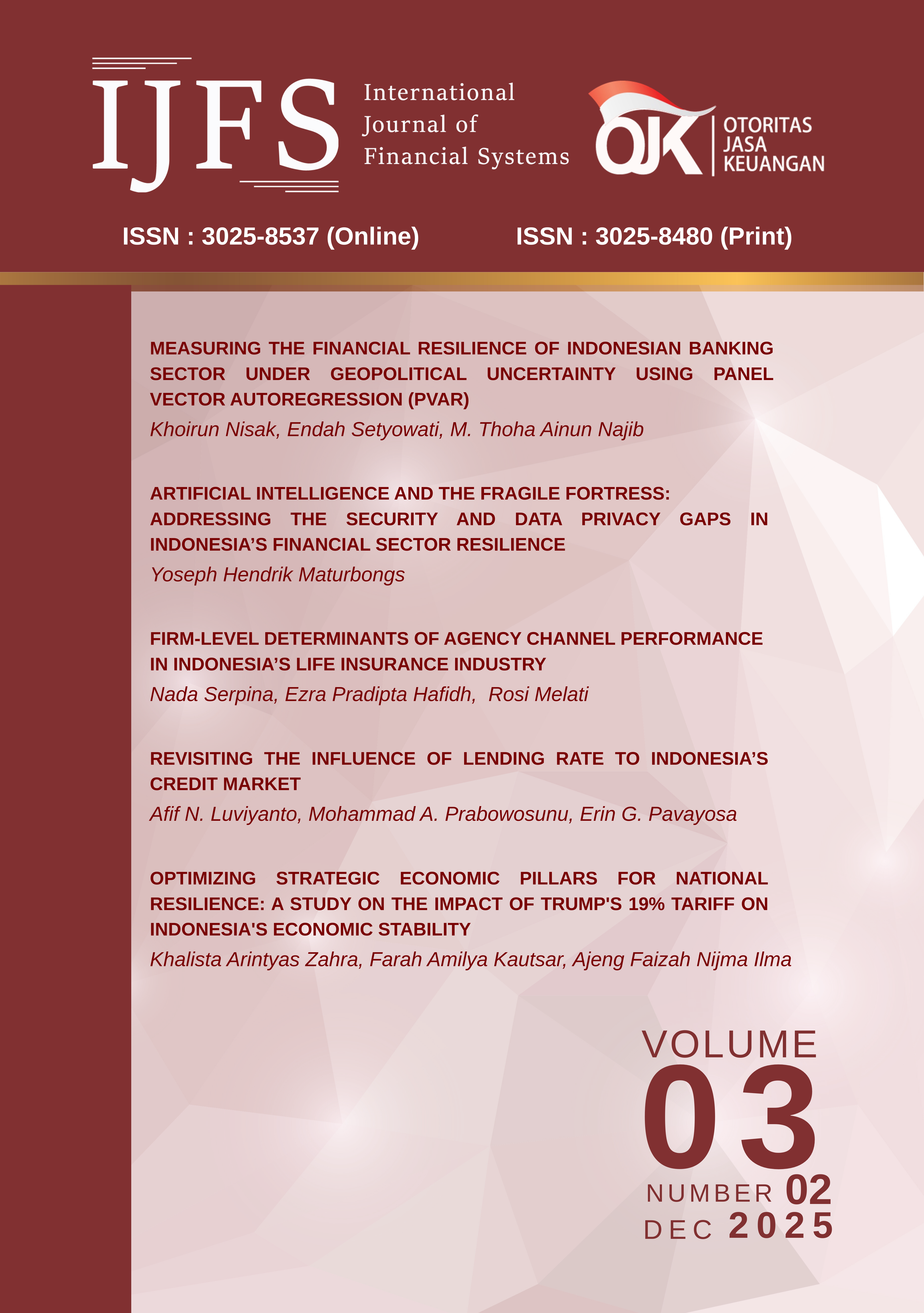
Artificial Intelligence and the Fragile Fortress
Addressing the Security and Data Privacy Gaps in Indonesia’s Financial Sector Resilience
DOI:
https://doi.org/10.61459/ijfs.v3i2.89Keywords:
Artificial Intelligence, Financial Sector Resilience, ADIFL Syndrome, Digital Vulnerability, Policy DesignAbstract
Indonesia’s financial sector embodies a paradox of a “fragile fortress”: while Artificial Intelligence (AI) accelerates innovation and strengthens external facades, it simultaneously embeds systemic vulnerabilities within its digital architecture. To address this dichotomy, this article introduces the Algorithmic Digital Integrity Fault Lines Syndrome (ADIFL Syndrome) as a novel theoretical framework. ADIFL conceptualises six interlinked algorithmic risks, cyber-privacy vulnerability, data abuse by design, erosion of social legitimacy, infrastructure fragility, regulatory asymmetry, and AI service unreliability that collectively erode digital integrity. Using a qualitative-constructive methodology grounded in systemic theories and strategic case studies, the study demonstrates that these risks are not isolated incidents but manifestations of deeper structural fault lines. Findings reveal how compounding vulnerabilities undermine resilience and legitimacy, offering actionable policy recommendations to strengthen adaptive governance. Furthermore, the article proposes the Digital Integrity Risk Index (DIRI) as a future evaluative tool, complete with measurable indicators for each ADIFL subset. By framing AI risks as emergent and interconnected phenomena, this research provides a conceptual foundation for building anticipatory digital resilience, relevant not only to finance but also to critical domains such as public services, healthcare, and education.
Downloads
References
Agudo, U., Liberal, K. G., Arrese, M., & Matute, H. (2024). The impact of AI errors in a human-in-the-loop process. Cognitive Research: Principles and Implications, 9(1), 1. https://doi. org/10.1186/s41235-023-00529-3
Akerlof, G. A. (1978). The market for “lemons”: Quality uncertainty and the market mechanism. Uncertainty in economics (pp. 235–251). https://doi.org/10.1016/B978-0-12-214850-7.50022-X
Alfrink, K., Keller, I., Kortuem, G., & Doorn, N. (2022). Contestable AI by design: Towards a framework. Minds and Machines, 33(4), 613–639. https://doi.org/10.1007/s11023-022-09611-z
Alrasheed, G., & Lim, M. (2021). Beyond a technical bug: Biased algorithms and moderation are censoring activists on social media. The Conversation. https://theconversation.com/beyond-a-technical-bug-biased-algorithms-and-moderation-are-censoring-activists-on-social-media-160669
Bahoo, S., Cucculelli, M., Goga, X., & Mondolo, J. (2024). Artificial intelligence in finance: A comprehensive review through bibliometric and content analysis. SN Business & Economics, 4(2), 23. https://doi.org/10.1007/s43546-023-00618-x
Bank for International Settlements. (2023). A step toward new financial market infrastructure: Infrastructure: Bank of Korea’s initiative. Bank of Korea, Bank for International Settlements. https://www.bis.org/publ/othp77.pdf
Basak, A., & Tiwari, D. (2025). API security risk and resilience in financial institutions. Laurea. https:// www.theseus.fi/handle/10024/883344
Batool, A., Zowghi, D., & Bano, M. (2025). AI governance: A systematic literature review. AI and Ethics, 5(3), 3265–3279. https://doi.org/10.1007/s43681-024-00653-w
Bayamlıoğlu, E. (2022). The right to contest automated decisions under the general data protection regulation: Beyond the so-called “right to explanation.” Regulation & Governance, 16(4), 1058–1078. https://doi.org/10.1111/rego.12391
Boivin, J. (2025). The ecological catastrophe of algorithmic individuation: Technological mediation and its social implication in the age of the anthropocene. In D. Binns & R. Najdowski (Eds.), Confronting the climate crisis: Activism, technology and ecoaesthetics (pp. 293–311). https:// doi.org/10.1007/978-3-031-89606-4_15
Buolamwini, J., & Gebru, T. (2018). Gender shades: Intersectional accuracy disparities in commercial gender classification. Proceedings of Conference on Fairness, Accountability, and Transparency, 77–91. https://proceedings.mlr.press/v81/buolamwini18a
Cahyani, F. D., & Maria, N. S. B. (2023). Analisis stabilitas sistem keuangan dan faktor-faktor yang mempengaruhinya. Diponegoro Journal of Economics, 12(3), 57–61. https://doi.org/10.14710/djoe.39983
Cate, M. (2025). Data privacy risks and vulnerabilities in API-driven financial ecosystems. ResearchGate. https://www.researchgate.net/publication/392070830_Data_Privacy_Risks_and_Vulnerabilities_in_API-Driven_Financial_Ecosystems
Chang, X. (2023). Gender bias in hiring: An analysis of the impact of Amazon’s recruiting algorithm.Advances in Economics Management and Political Sciences, 23(1), 134–140. https:// doi.org/10.54254/2754-1169/23/20230367
Cristine, M. A., Risakota, F. M. A., & Sirait, S. R. C. (2025). Perlindungan data pribadi dalam sistem skoring kredit otomatis oleh fintech di indonesia: Analisis yuridis normatif berdasarkan Undang-Undang Nomor 27 Tahun 2022. Jurnal Studi Hukum Modern, 7(3), Article 3. https:// journalversa.com/s/index.php/jshm/article/view/860
Cypriva. (2025, March 8). Kebocoran data pribadi di indonesia: Ancaman, kasus, dan solusi strategis. Cypriva. https://www.cypriva.id/articles/kebocoran-data-pribadi-di-indonesia-ancaman-nyata-kasus-terkini-dan-solusi-pencegahannya-
Dellaert, B. G. C., Baker, T., & Johnson, E. J. (2024). Regulating robo-advice for consumers’ financial decisions: The interplay between algorithm quality & digital choice architecture. Behavioral Science & Policy, 10(2), 1–7. https://doi.org/10.1177/23794607241296686
Detikinet. (2021, July 28). Kominfo Investigasi Dugaan Kebocoran Data 2 Juta Pengguna BRI Life. Detikinet. https://inet.detik.com/security/d-5659592/kominfo-investigasi-dugaan-kebocoran-data-2-juta-pengguna-bri-life
Dorochowicz, A., Jankowski, D., Ksieniewicz, P., Topolska, K., Topolski, M., & Zyblewski, P. (2025). A Prototype of an AI-driven operational security system for fintechs: A FaaS-based approach to fraud detection. Progress in Pattern Classification and Machine Learning (pp. 103– 112). https://doi.org/10.1007/978-3-032-01773-4_11
von Eschenbach, W. J. (2021). Transparency and the black box problem: Why we do not trust AI. Philosophy & Technology, 34(4), 1607–1622. https://doi.org/10.1007/s13347-021-00477-0
Eubanks, V. (2018). Automating inequality: How high-tech tools profile, police, and punish the poor. St. Martin’s Press.
European Union. (2016). Regulation (EU) 2016/679 of the European Parliament and of the Council of 27 April 2016. https://eur-lex.europa.eu/eli/reg/2016/679/oj/eng
Fitriyanti, F., Devty, S., Putri, S., & Thora, R. E. (2024). Securing personal data in e-KYC: Vital for digital economy growth. Diponegoro Law Review, 9(1), 104–120. https://doi.org/10.14710/dilrev.9.1.2024.104-120
Fredrikson, M., Jha, S., & Ristenpart, T. (2015). Model inversion attacks that exploit confidence information and basic countermeasures. Proceedings of the 22nd ACM SIGSAC Conference on Computerand Communications Security, 1322–1333. https://doi.org/10.1145/2810103.2813677
Financial Stability Board. (2024). The Financial stability implications of artificial intelligence. https://www.fsb.org/uploads/P14112024.pdf
Fursov, I., Morozov, M., Kaploukhaya, N., Kovtun, E., Rivera-Castro, R., Gusev, G., Babaev, D., Kireev, I., Zaytsev, A., & Burnaev, E. (2021). Adversarial attacks on deep models for financial transaction records. Proceedings of the 27th ACM SIGKDD Conference on Knowledge Discovery & Data Mining, 2868–2878. https://doi.org/10.1145/3447548.3467145
Gordon, Faith. 2019. Virginia Eubanks (2018) automating inequality: How high-tech tools profile, police, and punish the poor. New York: Picador, St Martin’s Press. Law, Technology and Humans 1 (November):162-64. https://doi.org/10.5204/lthj.v1i0.1386
Grennan, J. (2022). Fintech regulation in the United States: Past, present, and future. SSRN. https://papers.ssrn.com/sol3/papers.cfm?abstract_id=4045057
Gupta, M., Akiri, C., Aryal, K., Parker, E., & Praharaj, L. (2023). From ChatGPT to ThreatGPT: Impact of generative AI in cybersecurity and privacy. IEEE Access, 11, 80218–80245. https://doi.org/10.1109/ACCESS.2023.3300381
Hidayanti, N. F., Ariani, Z., & Syaharuddin, S. (2025). The integration of artificial intelligence in Islamic financial services: A review on digital innovation for sharia financial inclusion. Integrating Religion, Social Economy, and Law: Conference Series, 1(1), 8–17. https://journal. ummat.ac.id/index.php/ics/article/view/32559
Holland, J. H. (1992). Complex adaptive systems. Daedalus, 121(1), 17–30.
Hughes, H. P. N., Clegg, C. W., Bolton, L. E., & Machon, L. C. (2017). Systems scenarios: A tool for facilitating the socio-technical design of work systems. Ergonomics, 60(10), 1319–1335. https:// doi.org/10.1080/00140139.2017.1288272
Iqbar, M. D., Darrel, M., & Akilah, U. I. (2024). Analisis politik luar negeri indonesia dinamika dan tantangan lima tahun terakhir. Researchgate. https://doi.org/10.13140/RG.2.2.34325.95203
Iyer, S. (2022). Operational Resilience for Financial Institutions [PhD thesis, Trident University International].
Insurtech Asia. (2023). InsureTech Connect Asia 2023 summary report. Abeam Consulting. https:// www.abeam.com/id/en/insights/insure_tech_2023/
Jaakkola, E. (2020). Designing conceptual articles: Four approaches. AMS Review, 10(1–2), 18–26. https://doi.org/10.1007/s13162-020-00161-0
James, U. U., Idika, C. N., Enyejo, L. A., Abiodun, K., & Enyejo, J. O. (2024). Adversarial attack detection using explainable AI and generative models in real-time financial fraud monitoring systems. International Journal of Scientific Research and Modern Technology, 3(12), 142–157. https://doi.org/10.38124/ijsrmt.v3i12.644
Javia, S. (2025, March 27). Kesenjangan besar dalam AI: Pemimpin di sektor jasa keuangan hadapi tantangan tata kelola data dan tuntutan infrastruktur. IndonesiaSatu.co. https://indonesiasatu.co/detail/kesenjangan-besar-dalam-ai--pemimpin-di-sektor-jasa-keuangan-hadapi-tantangan-tata-kelola-data-dan-tuntutan-infrastruktur
Kandpal, V., Ozili, P. K., Jeyanthi, P. M., Ranjan, D., & Chandra, D. (2025). Digital finance and metaverse in banking: Decoding a virtual reality towards financial inclusion and sustainable development (pp. 181–198). Emerald Publishing Limited. https://www.emerald.com/insight/content/doi/10.1108/978-1-83662-088-420251009/full/html
Karakasilioti, G. M. (2024). Supporting the digital operational resilience of the financial sector: The EU’s DORA digital operational resilience act [Master thesis, University of Piraeus]
Lachmann, N. (2025). Chasing the elusive bird?: The technological development of the digital economy and international trade law’s susceptibility to a pacing problem. The Journal of World Investment & Trade, 26(3), 479–511. https://doi.org/10.1163/22119000-12340368
Lewis, J. D., & Weigert, A. (1985). Trust as a social reality. Social Forces, 63(4), 967–985. https://doi.org/10.1093/sf/63.4.967
Li, Q. (2025). Research on consumer data sovereignty and algorithmic fairness. International Journal of Management Science Research, 8(4), 6–10.
Lim, T. (2024). Environmental, social, and governance (ESG) and artificial intelligence in finance: State-of-the-art and research takeaways. Artifcial Intelligence Review, 57(76), 1–64. https://doi. org/10.1007/s10462-024-10708-3
Lu, S. (2022). Data privacy, human rights, and algorithmic opacity. California Law Review. 110, 2087. https://doi.org/10.15779/Z38804XM07
Luhmann, N. (1979). Trust and Power. John Wiley & Sons.
Luthfah, D. (2024). Penguatan keamanan siber pada sektor jasa keuangan Indonesia. Jurnal Penelitian dan Karya Ilmiah Lembaga Penelitian Universitas Trisakti, 9(1), 259–267. https:// doi.org/10.25105/pdk.v9i1.18643
MacInnis, D. J. (2011). A framework for conceptual contributions in marketing. Journal of Marketing, 75(4), 136–154. https://doi.org/10.1509/jmkg.75.4.136
Malatji, M., & Tolah, A. (2025). Artificial intelligence (AI) cybersecurity dimensions: A comprehensive framework for understanding adversarial and offensive AI. AI and Ethics, 5(2), 883–910. https://doi.org/10.1007/s43681-024-00427-4
Minkkinen, M., Laine, J., & Mäntymäki, M. (2022). Continuous auditing of artificial intelligence: A conceptualization and assessment of tools and frameworks. Digital Society, 1(3), 21. https:// doi.org/10.1007/s44206-022-00022-2
Monetary Authority of Singapore. (2018). Principles to promote fairness, ethics, accountability and transparency (FEAT) in the use of artificial intelligence and data analytics in Singapore’s financial sector (p. 15). https://www.mas.gov.sg/-/media/mas/news-and-publications/monographs-and-information-papers/feat-principles-updated-7-feb-19.pdf
Monetary Authority of Singapore. (2024). Artificial intelligence model risk management: Observations from a thematic review (pp. 1–50). https://www.mas.gov.sg/-/media/mas-media-library/publications/monographs-or-information-paper/imd/2024/information-paper-on-ai-risk-management-final.pdf
Neumannová, A., Bernroider, E. W. N., & Elshuber, C. (2023). The digital operational resilience act for financial services: A comparative gap analysis and literature review. Information Systems (Vol. 464, pp. 570–585). https://doi.org/10.1007/978-3-031- 30694-5_40
Nguyen, V.-L., Lin, P.-C., Cheng, B.-C., Hwang, R.-H., & Lin, Y.-D. (2021). Security and privacy for 6G: A survey on prospective technologies and challenges. IEEE Communications Surveys & Tutorials, 23(4), 2384–2428. https://doi.org/10.1109/COMST.2021.3108618
Novelli, C., Hacker, P., McDougall, S., Morley, J., Rotolo, A., & Floridi, L. (2025). Getting regulatory sandboxes right: Design and governance under the AI act. SSRN. https://dx.doi.org/10.2139/ssrn.5332161
Otoritas Jasa Keuangan. (2025). Tata kelola kecerdasan artifisial perbankan Indonesia. https://www.ojk.go.id/id/Publikasi/Roadmap-dan-Pedoman/Perbankan/Documents/Tata%20Kelola%20Kecerdasan%20Artifisial%20Perbankan%20Indonesia.pdf
Panarese, P., Grasso, M. M., & Solinas, C. (2025). Algorithmic bias, fairness, and inclusivity: A multilevel framework for justice-oriented AI. AI & SOCIETY. https://doi.org/10.1007/s00146-025-02451-2
Parisot, M. P. M., Pejo, B., & Spagnuelo, D. (2021). Property inference attacks on convolutional neural networks: Influence and implications of target model’s complexity. ArXiv. https://doi.org/10.48550/arXiv.2104.13061
Power, M. (2022). Theorizing the economy of traces: From audit society to surveillance capitalism. OrganizationTheory, 3(3). https://doi.org/10.1177/26317877211052296
Pradana, A. E., Herawati, A. R., & Dwimawanti, I. H. (2025). Tantangan kecerdasan buatan dalam implikasi kebijakan pemerintah di indonesia: Studi literatur. Jurnal Good Governance, 51–66. https://doi.org/10.32834/gg.v21i1.889
Puannandini, D. A., Fabian, R., Firdaus, R. A. P., Mustopa, M. Z., & Herdiyana, I. (2025). Liabilitas produk AI dalam sistem hukum Indonesia: Implikasi bagi pengembang, pengguna, dan penyedia layanan. Iuris Studia: Jurnal Kajian Hukum, 6(1), 24–33. https://doi.org/10.55357/is.v6i1.808
Purba, D. S., Permatasari, P. D., Tanjung, N., Rahayu, P., Fitriani, R., & Wulandari, S. (2025). Analisis perkembangan ekonomi digital dalam meningkatkan pertumbuhan ekonomi di Indonesia. Jurnal Masharif Al-Syariah: Jurnal Ekonomi dan Perbankan Syariah, 10(1). https:// journal.um-surabaya.ac.id/Mas/article/view/25367
Rafael, E. F. (2013). Technology as a social system: A systems theoretical conceptualization.Philippine Sociological Review, 319–347. https://www.jstor.org/stable/43486378
Rakovic, I. (2022). Dark finance: Exploring deceptive design in investment apps [Master thesis, Norwegian University of Science and Technology]. https://ntnuopen.ntnu.no/ntnu-xmlui/handle/11250/3005227
Rakovic, I., & Inal, Y. (2023). Dark finance: Exploring deceptive design in investment apps. Human-Computer Interaction–Interact 2023. (Vol. 14142, pp. 339–348). https://doi.org/10.1007/978-3-031-42280-5_20
Ravshan, K. (2025). Risks and regulatory challenges associated with fintech technologies. International Conference on Interdisciplinary Science, 2(6), 282–284. https://universalconference.us/universalconference/index.php/icms/article/view/4713
Respati, A. R., & Sukmana, Y. (2023, December 7). Evaluasi penyaluran KUR, dari debitur tak punya NPWP sampai biaya “siluman”. KOMPAS.com. https://money.kompas.com/ read/2023/12/07/194311126/evaluasi-penyaluran-kur-dari-debitur-tak-punya-npwp-sampai- biaya-siluman
Romeo, G., & Conti, D. (2025). Exploring automation bias in human–AI collaboration: A review and implications for explainable AI. AI & SOCIETY. https://doi.org/10.1007/s00146-025- 02422-7
Ryan, M., Withers, G., & Den Hartog, F. (2024). The cloud conundrum: Are financial institutions heading for a catastrophic disruption event? IEEE Transactions on Technology and Society. https://ieeexplore.ieee.org/abstract/document/10706249/
Sandy, K. F. (2025, February 9). Begini strategi OJK hadapi serangan siber perbankan. IDX Channel. https://www.idxchannel.com/banking/begini-strategi-ojk-hadapi-serangan-siber-perbankan
Sankalp, M. R., Lokapal, G., Mohan, B. A., & Basavaraj, G. N. (2025). Addressing cybersecurity challenges in 6G Networks through AI-driven adaptive defense mechanisms and quantum-resilient protocols. Proceedings of the 2025 International Conference on Computing for Sustainability and Intelligent Future (COMP-SIF), 1–12. https://ieeexplore.ieee.org/abstract/document/10969886/
Setyowati, D. (2025, April 10). Kronologi sistem Bank DKI eror, data dan dana nasabah aman? Katadata.co.id. https://katadata.co.id/digital/teknologi/67f74c66822b5/kronologi-sistem-bank-dki-eror-data-dan-dana-nasabah-aman
Shabrina, Dinda. (2025, February 12). Sempat error berhari-hari, sistem IT pada aplikasi Byond dari BSI kini diklaim sudah stabil. Tempo. https://www.tempo.co/ekonomi/sempat-error-berhari-hari-sistem-it-pada-aplikasi-byond-dari-bsi-kini-diklaim-sudah-stabil-1205998
Shahnaz, K. (2021, Agustus). BTPN soal pembobolan nasabah Jenius: Itu ulah social engineering. Bisnis.com. https://finansial.bisnis.com/read/20210826/90/1434378/btpn-soal-pembobolan-nasabah-jenius-itu-ulah-social-engineering
Singh, S., Rahman, A., & Kaur Johl, S. (2025). The looming labyrinth: Risks of artificial intelligence in financial sector. In (Eds) Green Horizons: Role of AI in Sustainable Finance (pp. 215–235). Springer. https://doi.org/10.1007/978-981-96-6495-5_12
Stiglitz, J. E., & Weiss, A. (1981). Credit rationing in markets with imperfect information. The American Economic Review, 71(3), 393–410. http://www.jstor.org/stable/1802787
Sun, J., Zhao, M., & Lei, C. (2024). Class-imbalanced dynamic financial distress prediction based on random forest from the perspective of concept Drift. Risk Management, 26(4), 19. https:// doi.org/10.1057/s41283-024-00150-8
Susilo, A. (2023). Regulatory technology untuk digitalisasi proses kepatuhan (Studi kasus bank swasta di Indonesia). Infotech Journal, 9(1), 252–258. https://doi.org/10.31949/infotech.v9i1.5460
Thalpage, N. (2023). Unlocking the black box: Explainable artificial intelligence (XAI) for trust and transparency in AI systems. Journal of Digital Art & Humanities, 4(1), 31–36. https:// doi.org/10.33847/2712-8148.4.1_4
Trinh, T. K., & Zhang, D. (2024). Algorithmic fairness in financial decision-making: Detection and mitigation of bias in credit scoring applications. Journal of Advanced Computing Systems, 4(2), 36–49. https://doi.org/10.69987/JACS.2024.40204
Trisnawati. (2024). Artificial intelligence governance and regulation: A roadmap to developing legal policies for artificial intelligence deployment. Journal of Governance and Administrative Reform, 5(2), 185–194. https://doi.org/10.20473/jgar.v5i2.65194
Trist, E. L. (1981). The evolution of socio-technical systems: A conceptual framework and an action research program. Ontario Ministry of Labour. https://sistemas-humano-computacionais.wdfiles.com/local--files/capitulo%3Aredes-socio-tecnicas/Evolution_of_socio_technical_systems.pdf
Veale, M., Binns, R., & Edwards, L. (2018). Algorithms that remember: Model inversion attacks and data protection law. Philosophical Transactions of the Royal Society A: Mathematical, Physical and Engineering Sciences, 376(2133), 20180083. https://doi.org/10.1098/rsta.2018.0083
Verbeek, P.-P. (2023). Postphenomenology and ethics. In Technology Ethics (pp. 42–51). Routledge. https://www.taylorfrancis.com/chapters/edit/10.4324/9781003189466-8/postphenomenology- ethics-peter-paul-verbeek
Walter, Y. (2024). Managing the race to the moon: Global policy and governance in artificial intelligence regulation, a contemporary overview and an analysis of socioeconomic consequences. Discover Artificial Intelligence, 4(1). https://doi.org/10.1007/s44163-024-00109-4
Yaksan, S. (2024). Regulating AI with a legal policy fuelled by innovation and accountability: Regulatory sandboxes as the way forward. SSRN. https://papers.ssrn. com/sol3/papers.cfm?abstract_id=5068132
Zhang, X., Wang, T., Ma, L., & Mahadevan, S. (2025). Reliability engineering, risk management, and trustworthiness assurance for AI systems. Journal of Reliability Science and Engineering, 1(2), 022001. https://doi.org/10.1088/3050-2454/adcef2
Zhang, Y., & Wildemuth, B. M. (2009). Qualitative Analysis of Content. In B. M. Wildemuth, Ed., Applications of Social Research Methods to Questions in Information and Library Science, Libraries Unlimited, 2009. pp. 1-12.
Zhang, Z., Ning, H., Shi, F., Farha, F., Xu, Y., Xu, J., Zhang, F., & Choo, K.-K. R. (2022). Artificial intelligence in cyber security: Research advances, challenges, and opportunities. Artificial Intelligence Review, 55(2), 1029–1053. https://doi.org/10.1007/s10462-021-09976-0
Zuboff, S. (2023). The Age of Surveillance Capitalism. In Social theory re-wired (pp. 203–213). Routledge. https://www.taylorfrancis.com/chapters/edit/10.4324/9781003320609-27/age- surveillance-capitalism-shoshana-zuboff
Downloads
Published
How to Cite
Issue
Section
License
Copyright (c) 2026 The International Journal of Financial Systems

This work is licensed under a Creative Commons Attribution-NonCommercial 4.0 International License.
IJFS article's license is CC-BY-NC. Authors grant the journal/publisher publishing rights with the work simultaneously licensed under a Creative Commons Attribution-NonCommercial 4.0 International License.